From coalfield closures to a blueprint for clean offshore hydrogen
I watched friends lose their jobs in the 1980s when the pits closed. Entire towns were left to die a slow economic death. Project Britannia is my attempt to make sure we don't repeat that mistake with the North Sea – and to use our offshore skills to help save the climate instead of destroying it.
Why Project Britannia Exists: A Personal Story
In the 1980s I watched coal pits close and whole communities unravel. Friends who thought they had a job for life were suddenly on the employment scrap heap. Pubs shut, shops emptied, streets went quiet. We didn't just lose wages – we lost identity, purpose, and pride.
What struck me most was not that the mines closed – that was inevitable in a changing world – but that we had
no real plan for what came next. There was no serious pathway to move those skills into new industries. People and towns were simply left behind.
Today, the North Sea faces its own "pit closure" moment. Oil and gas platforms are approaching end of life.
If we repeat the 1980s – shut it all down, scrap the kit, and walk away – we will waste skills, wreck communities, and miss a once‑in‑a‑century chance to do something better.
The choice we face: a degraded planet or a thriving future
From Industrial Revolution to Climate Crisis
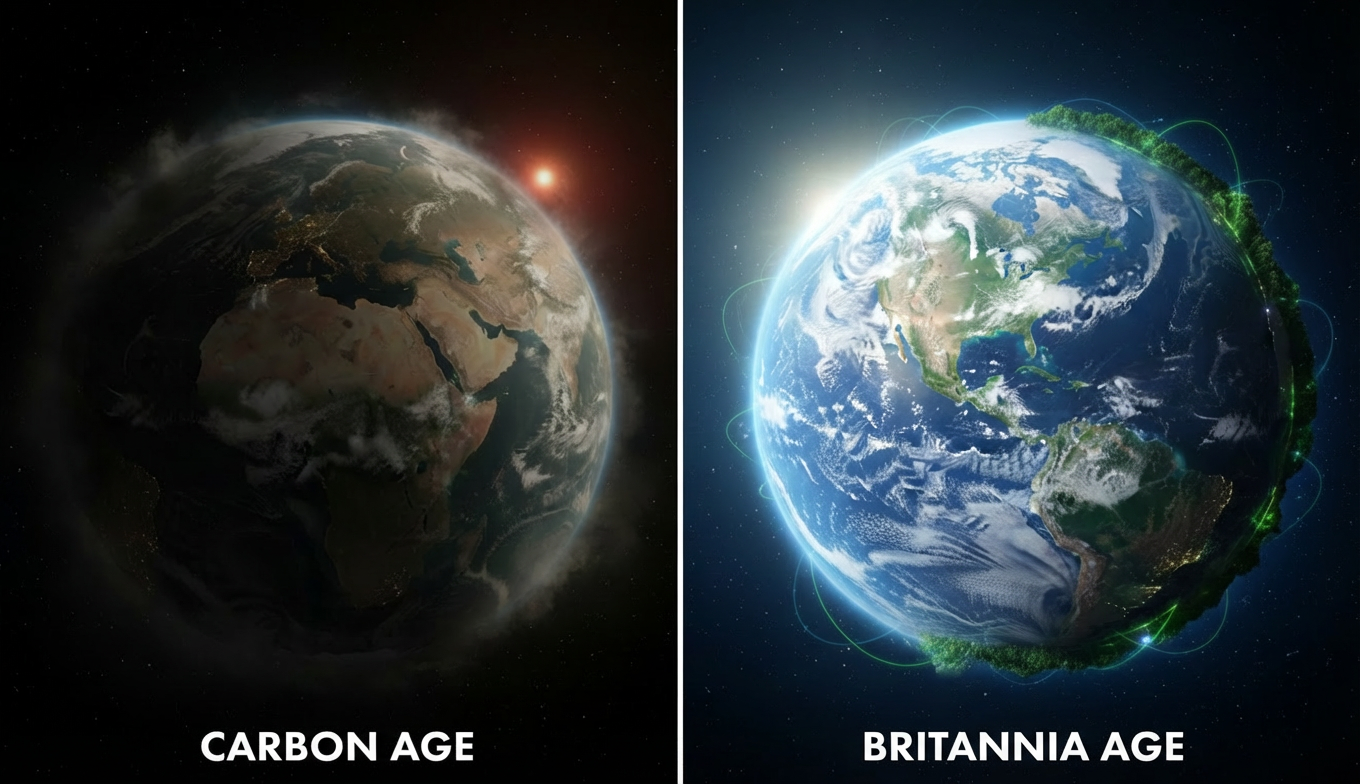
For millions of years, the Earth managed its own balance. Carbon moved slowly between air, oceans, rock and living things. Then we lit the fuse of the industrial revolution. We stepped out of the natural ecosystem and started to burn in a century what had taken nature millions of years to store underground.
We are now at the point where we are damaging the very planet that supported us since time began. The atmosphere and oceans are telling us clearly: this way of burning carbon cannot continue.
My Proposal: Step Back Into Line With Nature
Project Britannia is built on a simple idea:
stop burning carbon and start borrowing from nature instead.
Instead of digging up carbon and setting it on fire, we use something we cannot destroy –
the water cycle.
We split water into hydrogen and oxygen using clean power. We use the hydrogen as fuel. When it is burned or used in a fuel cell, it turns straight back into water and returns to the sea, just as it has done for millions of years.
Nothing is permanently consumed. We borrow hydrogen molecules for a while, use them to power our country, and then they quietly go back into the natural cycle.
Not from a boardroom – from a retired engineer with a brain and a conscience
This is the heart of Britannia: a system that borrows from nature and pays it back, instead of ripping up carbon and dumping it into the sky.
The Britannia Charter
Principles for UK Ownership, UK Jobs, and UK Control
Uniform Layout Edition prepared for MPs, ministers, media and the public (2026)
What this is: A principles document setting the non-negotiables for a British-first Project Britannia—protecting UK sovereignty, UK workers, and UK control.
Preamble
Project Britannia proposes to convert selected end-of-life offshore oil and gas platforms in UK waters into nuclear-powered hydrogen production facilities. The concept was conceived by David Waugh, a retired engineer who witnessed the devastation of the 1980s coal mine closures and is determined that offshore workers and communities will not suffer the same fate.
The Britannia Charter sets out the core principles that must govern any development, financing, or deployment of this project. These principles are designed to ensure that Britannia remains a UK-led, UK-controlled initiative that delivers tangible benefits to UK workers, communities, and the national interest.
“In the 1980s, we abandoned coal communities. In the 2030s, we choose a different path.” — David Waugh
Core Principles
UK Ownership and Control of Intellectual Property
All core intellectual property relating to the Britannia concept—including platform conversion methods, safety architecture, reactor integration designs, and operational procedures—shall be owned by a UK-registered entity or entities, subject to UK law.
Any licensing, joint ventures, or partnerships with non-UK entities must preserve majority UK ownership and control of the core IP.
Technology transfer or sale of IP to foreign entities requires explicit approval from UK government authorities and must demonstrate clear national benefit.
UK Jobs First
Britannia shall prioritise the employment, training, and transition of existing UK offshore workers particularly those in the North Sea oil and gas sector facing job losses due to decommissioning.
A minimum of 70% of the workforce engaged in Britannia projects shall be UK-based.
Britannia shall establish or support a recognised Skills Passport scheme to enable offshore oil and gas workers to transition into nuclear-hydrogen roles.
Priority regions for employment and training: Aberdeen and Aberdeenshire, Teesside, Humberside, and other North Sea-adjacent communities.
UK Regulatory Jurisdiction
All Britannia facilities shall operate under UK regulatory oversight, including but not limited to the Office for Nuclear Regulation (ONR), Health and Safety Executive (HSE), North Sea Transition Authority (NSTA), and UK environmental and marine regulators.
No Britannia facility shall be subject to foreign regulatory jurisdiction that could override UK safety, environmental, or operational standards.
Use of UK Technology Where Possible
Britannia shall prioritise the use of UK-designed and UK-manufactured technology where feasible, particularly:
Small Modular Reactors (SMRs) designed in the UK (e.g. Rolls-Royce SMR or equivalent UK designs once licensed).
UK-based engineering, procurement, and construction (EPC) contractors.
UK supply chain for critical components, systems, and services.
Where non-UK technology is required, preference shall be given to partners from allied nations with strong technology-sharing agreements with the UK.
Community and Worker Transition Guarantees
Britannia commits to a genuine just transition for offshore workers and communities:
No compulsory redundancies for workers willing to retrain for Britannia roles.
Funded retraining and upskilling programmes, with income support during transition periods.
Community investment funds for Aberdeen, Teesside, Humberside, and other affected regions to support economic diversification.
Transparent consultation with trade unions (GMB, Unite, RMT, Prospect) and local authorities throughout project development.
Transparency and Accountability
Britannia shall operate with full transparency regarding:
Ownership structure and beneficial ownership of all entities involved.
Safety performance, environmental compliance, and regulatory engagement.
Employment numbers, workforce composition, and training outcomes.
Financial performance and use of public funds (if any).
An independent oversight board, including worker and community representatives, shall be established to monitor adherence to this Charter.
Commitment
By endorsing this Charter, we commit to ensuring that Project Britannia remains a UK-led initiative that delivers real benefits to UK workers, communities, and the national interest. We will not support any development of Britannia that compromises these principles or transfers control, ownership, or intellectual property to foreign entities without clear safeguards and demonstrable UK benefit.
Endorsements
This Charter is open for endorsement by:
Trade unions and worker representatives
Local authorities and regional mayors
Members of Parliament and devolved government representatives
Industry bodies and professional associations
Community groups and civil society organisations
Project Britannia — Conceived by David Waugh, Retired Engineer
Who Loses If We Get This Wrong? The Just Transition Case
The 1980s coal closure lesson: When we shut down an industry without a plan, we don't just lose jobs – we lose entire communities, skills bases, and regional identities. The scars last for generations.
As oil, gas, and natural gas wind down, we face the same risk across multiple sectors. Project Britannia is designed to prevent that repeat.
The Scale of What's at Risk
The transition away from fossil fuels is necessary and inevitable. But without a credible plan to redirect skills and anchor new industries in the same places, we risk creating multiple "coal closure" moments across the UK energy system.
120,000+
Gas Safe Engineers
Domestic and commercial gas engineers, heating installers, and LPG specialists – many are small businesses or sole traders.
Risk: Shrinking market as natural gas is phased out.
✓ Britannia Fix: Retrain for hydrogen-ready boilers, hydrogen network maintenance, and safety certification
Tens of thousands
Offshore Oil & Gas Workers
Platform crews, subsea engineers, ROV pilots, drillers, well services, control room operators, scaffolders, rope access, medics.
Risk: Job losses as platforms are decommissioned without replacement work.
✓ Britannia Fix: Direct transfer to offshore reactor operations, hydrogen plant maintenance, subsea hydrogen pipelines
Thousands
Fabrication & Engineering Yards
Steel fabrication, pressure vessels, skids, structural modules in Aberdeen, Teesside, Humberside, Great Yarmouth.
Risk: Loss of work as offshore construction winds down.
✓ Britannia Fix: Build hydrogen process modules, SMR support structures, maintain offshore hydrogen infrastructure
Thousands
Logistics & Marine Supply
Vessel operators, port workers, warehouse staff, fuel suppliers, pilots supporting offshore operations.
Risk: Ports become stranded assets as offshore activity declines.
✓ Britannia Fix: Support hydrogen rig operations, export hydrogen/ammonia via existing port infrastructure
Thousands
Engineering Consultancies
Process, mechanical, structural, electrical, control & instrumentation, safety case authors.
Risk: Decommissioning-only work is terminal – short boom, then nothing.
✓ Britannia Fix: Design and safety case work for hydrogen platforms, long-term operations support
Risk: Loss of ongoing inspection work as assets are scrapped.
✓ Britannia Fix: Ongoing integrity management for repurposed platforms and hydrogen systems
Thousands
Pipeline Operators & Integrity Teams
National Transmission System, regional gas networks, compressor stations, cathodic protection, pipeline integrity specialists.
Risk: Pipeline industry becomes decommissioning-only as gas demand falls.
✓ Britannia Fix: Convert pipelines for hydrogen, maintain and operate hydrogen transport infrastructure
Thousands
OEMs & Supply Chain Manufacturers
Boiler and burner manufacturers, valve/pump/compressor makers, control systems, gas detection, instrumentation.
Risk: Loss of domestic market as gas equipment is phased out.
✓ Britannia Fix: Pivot to hydrogen-compatible equipment, create early UK market pull for hydrogen kit
Hundreds
Training Providers & Colleges
Colleges teaching gas fitting, heating, offshore skills; awarding bodies (ACS, NVQ, SVQ for gas).
Risk: Training demand shrinks or vanishes without replacement pathways.
✓ Britannia Fix: "Gas Safe to Hydrogen Safe" evolution, new Hydrogen Safety and Offshore Hydrogen Technician pathways
The Knock-On Effects: Whole Towns at Risk
Beyond the direct energy jobs, there are thousands more roles that depend on the wage base these industries create:
Domestic installers and retailers of gas appliances (showrooms, merchants)
Insurance and inspection services tied to gas equipment
Local high streets in oil & gas and industrial towns: pubs, shops, services that rely on those wages
Housing markets and local tax bases in Aberdeen, Teesside, Humberside, and other offshore hubs
The Decommissioning Trap: Without something like Britannia, decommissioning becomes a terminal industry – a short-term boom in removals, then a cliff edge. Yard jobs, offshore crews, and engineers get a burst of work and then nothing.
Britannia's alternative: Turn a subset of end-of-life platforms into long-lived hydrogen/energy assets. This extends employment for decades, not just 5–10 years, and gives decommissioning firms a second line of business: repurposing, not just scrapping.
The Political and Social Stakes
If we don't anchor new energy jobs in these same places, we risk:
Regional decline: Aberdeen, Teesside, and the Humber either get a new hydrogen economy – or a slow industrial death
Skills exodus: Highly trained workers forced to leave the UK or leave the industry entirely
Loss of industrial capability: The UK's offshore engineering expertise – built over 50 years – simply evaporates
Political backlash: Communities that feel abandoned again will not forget
How Britannia Directly Mitigates These Risks
Repurposed platforms → offshore jobs retained and extended
Hydrogen pipelines and appliances → Gas Safe skills reused, not discarded
Port fabrication and logistics → new build and maintenance work for hydrogen rigs & export
Training and certification → evolution, not extinction – "Gas Safe to Hydrogen Safe"
Regional anchoring → keeps Aberdeen, Teesside, and Humber as energy capitals instead of stranded industrial fossils
"We either give 120,000+ highly skilled people a future, or we repeat the 1980s coal mistake. Project Britannia is the plan we didn't have in the 1980s."
— Dave Waugh, Project Britannia originator
Never Again: Protecting Workers and Coastal Towns
What I Saw in the 1980s
When the coal mines closed, we didn't just lose an industry; we lost whole communities. There were no serious plans for retraining, no large‑scale, long‑term industrial replacement. People were told to "move on" from careers they had built over decades. Many never recovered.
What I See Coming in the North Sea
The North Sea oil and gas industry now stands at a similar turning point. A large share of our offshore platforms are approaching end of life. Public estimates suggest there are around
~600 production platforms across the whole North Sea basin, with roughly
~470 platforms in the UK sector.
Higher figures – around 1,500 offshore structures – typically refer to
all installations and subsea infrastructure combined: platforms, wellheads, templates, manifolds, pipelines, and other seabed equipment.
Crucially: not all of these platforms are suitable for reuse. Some are too old, too corroded, or too expensive to make safe for another life at sea. But many are not. Many could be given a new, clean purpose if we choose to invest wisely.
Where This Matters Most
Aberdeen: the operational brain and marine heart of our offshore industry
Teesport (Teesside): heavy industry, chemicals, fabrication and a hungry market for clean hydrogen
Humberside: one of the UK's largest industrial clusters, with refineries, steel and power stations needing firm low‑carbon fuel
These are the modern "pit villages" of the offshore era. If we simply shut down, scrap the assets and walk away, we risk repeating the 1980s:
towns hollowed out, workers discarded, skills wasted.
Project Britannia is designed as an alternative – a way to move offshore workers, ports and supply chains
from fossil extraction to clean production,
instead of pushing them off the cliff and hoping something turns up.
What Project Britannia Actually Does
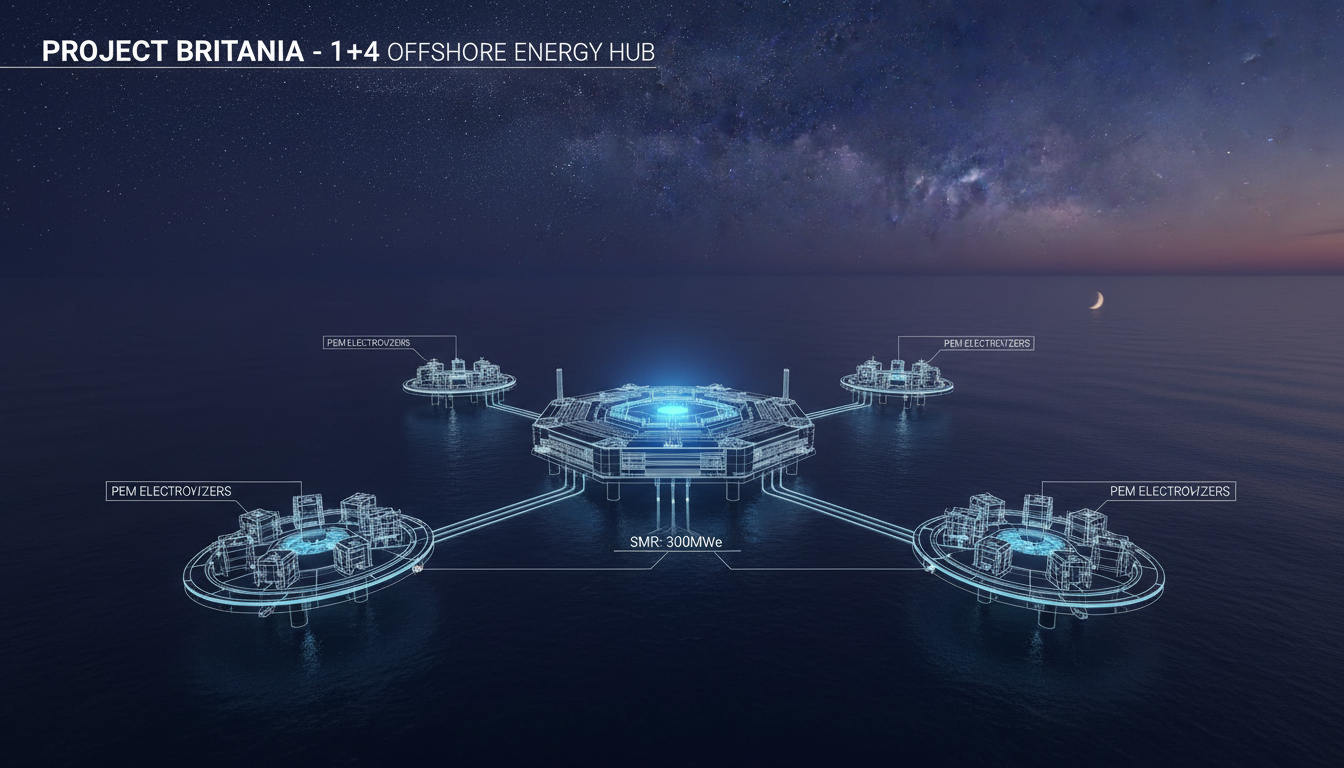
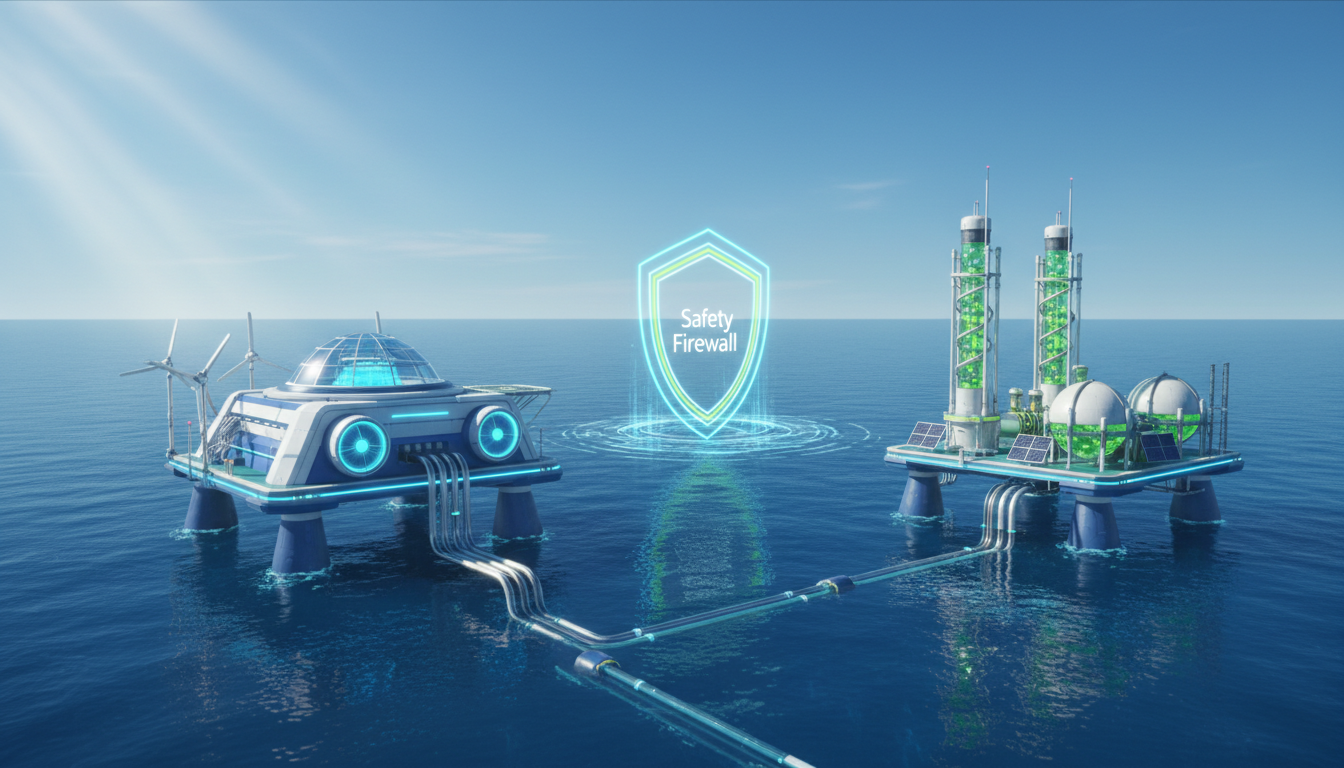
1 Power Hub + 4 Satellite Rigs
Britannia takes a simple layout:
one offshore nuclear Power Hub and
four nearby "satellite" platforms – typically
about 2 to 5 km apart in a mature field.
The offshore nuclear Power Hub – clean, firm electricity at sea
The Power Hub is an offshore Small Modular Reactor (SMR) – conceptually something like the UK Rolls‑Royce SMR design, which uses modern passive safety features. Any actual design would still need full ONR licensing.
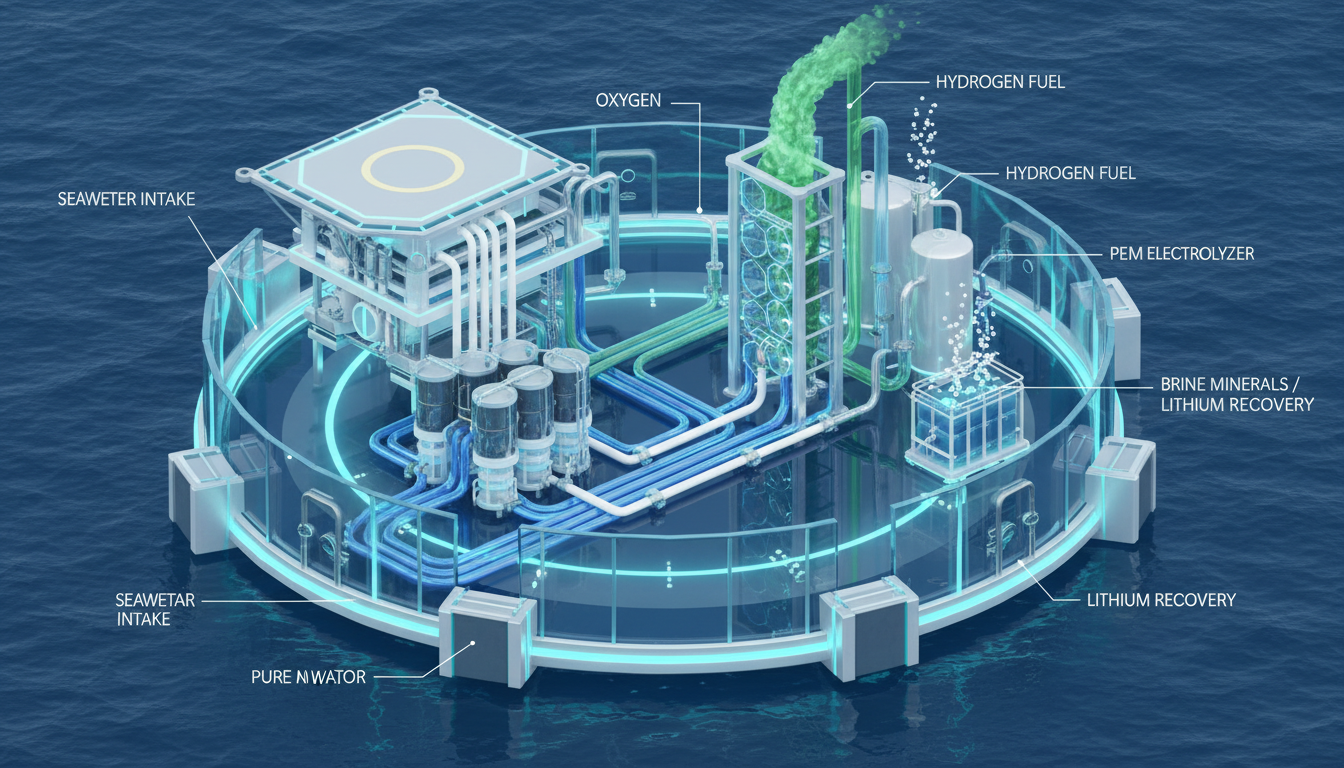
The 4 satellites are repurposed oil and gas platforms, stripped of hydrocarbons and rebuilt to host large PEM electrolysers, desalination, hydrogen compression and safety systems.
Short subsea cables carry power from the Hub to each satellite.
Hydrogen produced offshore is sent back to shore through existing pipeline corridors, once they are proven suitable or upgraded for hydrogen service.
Borrowing Hydrogen From the Sea
The core chemistry is beautifully simple and ancient:
We take seawater and clean it into pure water.
We use clean electricity from the SMR to split this water in an electrolyser into
hydrogen (H₂) and oxygen (O₂).
We use the hydrogen as a fuel and feedstock for Teesside, the Humber and beyond.
When the hydrogen is used, it reacts with oxygen and becomes water again, returning to the natural cycle.
We are not digging up carbon and throwing it into the sky. We are
borrowing hydrogen molecules from the ocean, using them, and handing them straight back as water.
In climate terms, Britannia is about as close as we can get to
"using nothing" – we temporarily rearrange water molecules to power our lives, then return them to the sea.
Circular Economy: Zero to Minimum Waste
Britannia is designed around a circular economy mindset:
nothing valuable is thrown away if it can be safely used.
Hydrogen: the main product – clean fuel and chemical feedstock.
Oxygen: captured as a saleable resource for industry, aquaculture and water treatment, rather than just vented.
Brine: instead of dumping desalination brine into the sea, the design goal is minimum to no routine discharge. Brine is:
Stored and sold for winter road de-icing,
Used as a chemical feedstock where markets exist,
Supplied to concrete and construction users,
Provided to fish farms and other aquaculture where appropriate.
Because de‑icer demand is strongly seasonal, Britannia treats brine as a
12‑month product cycle:
when winter demand is low, more goes to chemical plants, construction or other year‑round uses.
Optional lithium and mineral recovery: direct lithium extraction (DLE) and related technologies are evolving. They are
not assumed in the core business case, but if and when they are proven at scale, they could be added as a
spin‑off project to recover lithium and other minerals from the brine.
Safety Comes First
None of this works without safety. This is not a "shortcut" project – in fact it is the opposite:
it only works if regulators and the public trust it.
Nuclear safety: Any SMR must go through full ONR licensing. Offshore deployment is first‑of‑a‑kind and must be treated conservatively, with strong passive safety, robust containment, multiple barriers, and proven heat removal using the marine environment as a large heat sink.
Hydrogen safety: Hazardous area zoning, continuous leak detection, ventilation, blast and fire design, emergency isolation, and safe venting are all built into the platform designs.
Layout safety (1+4 configuration): Keeping the Power Hub and the four hydrogen satellites a few kilometres apart reduces the chance that a single incident can affect the whole system, and allows clear emergency and marine access routes.
For 131 t/day H₂: ~1,600-2,000 m³/day purified water
Desalination Load
Electrical load is small relative to electrolysis at this scale, but must be engineered for reliability and marine conditions.
Reverse osmosis (RO) is the baseline technology for offshore applications.
Co-Products
Oxygen: ~8 kg O₂ per kg H₂ produced; capture where demand exists (industrial, aquaculture)
Brine: Design goal is minimum to no routine discharge by collecting as saleable resource
Heat: Waste heat from electrolysis and SMR balance-of-plant may be recoverable
Powering the British Home: The Hydrogen Transition
A core pillar of Project Britannia is ensuring that the clean energy generated in the North Sea reaches the kitchen tables and radiators of British families without the need for expensive, disruptive home renovations.
The "Hydrogen‑Ready" Boiler
Leading UK manufacturers, including Worcester Bosch, Baxi, and Ideal, have already developed
hydrogen‑ready boilers. These units are designed to run on standard natural gas today but can be converted to 100% hydrogen in
approximately one hour by a qualified engineer swapping a small number of key components (such as the burner and some seals).
For most households, the boiler stays on the same wall, the pipes stay in the same places, and the radiators stay the same. The change is in the
fuel, not in the way people live.
Using the Gas Grid We Already Have
Unlike heat pumps, which often require major insulation upgrades and larger radiators in older British housing stock, hydrogen makes use of the
existing national gas network. The transition can happen largely "behind the scenes":
The gas grid in a region is converted to carry hydrogen instead of fossil gas.
Hydrogen‑ready boilers are converted over by engineers, street by street.
From the consumer's point of view, the heating system continues to work much as it does today.
The 20% Blend Opportunity: Most existing UK gas boilers can already operate on a blend of up to around 20% hydrogen in the gas stream with no changes to the boiler itself. That means that even before full conversion to 100% hydrogen, projects like Britannia can begin to lower the carbon intensity of home heating immediately by supplying low‑carbon hydrogen into the network as a blend.
"We aren't asking people to rip out their pipes or spend thousands on insulation they can't afford. We're changing the fuel, not the lifestyle."
— Dave Waugh, Project Britannia originator
Target Regions: Teesside & Humber
Teesside
Major chemicals and process industries
Port operations and fabrication capacity (Teesport)
Proximity to offshore corridors
Existing industrial hydrogen demand
O&M and supply chain potential
Humber
Largest industrial emissions cluster in UK
Refineries, chemicals, steel, power generation
Significant potential hydrogen offtake
Port infrastructure for logistics
Regional decarbonisation priority
Aberdeen & Wider Offshore Ecosystem
Offshore operations, vessel services, and engineering capacity can support delivery and workforce transition. Aberdeen's offshore expertise is critical to project execution and long-term operations.
Safety & Risk Management
The 1+4 safety layout: Power Hub and satellites separated by 2-5 km for emergency access and risk isolation
Nuclear Safety Posture
First-of-a-kind offshore nuclear deployment must be treated conservatively.
Any SMR requires ONR (Office for Nuclear Regulation) licensing
Offshore configuration requires bespoke safety case
Brine Management (Minimum to No Routine Discharge)
Design Goal: Collect brine as a resource and sell to shore-based users. Any unavoidable discharge would require permitting and engineered environmental controls.
Brine Applications
Seasonal de-icing (roads, airports)
Chemical feedstock (chlor-alkali, soda ash)
Concrete and construction applications
Aquaculture salinity management
Food processing (brining, curing)
Industrial cooling systems
Drilling fluids (oil & gas, geothermal)
Water treatment (regeneration)
Brine Logistics
Requires storage, handling, shipping/pipeline logistics, and offtaker agreements. Seasonal storage planning is critical for de-icing demand matching.
Oxygen Co-Product
Electrolysis produces ~8 kg oxygen per kg hydrogen. Britannia proposes capturing oxygen where there is local demand:
Industrial processes (steel, chemicals, glass)
Aquaculture (fish farming oxygenation)
Medical/healthcare (subject to purity standards)
Wastewater treatment
Where not captured, oxygen must be managed safely and in compliance with offshore safety requirements.
Optional Mineral Recovery (e.g., Lithium)
Direct Lithium Extraction (DLE) and related recovery technologies may be evaluated as an optional pilot-linked extension.
The core business case should not depend on lithium revenue until proven at operational scale. Treat as optional upside only.
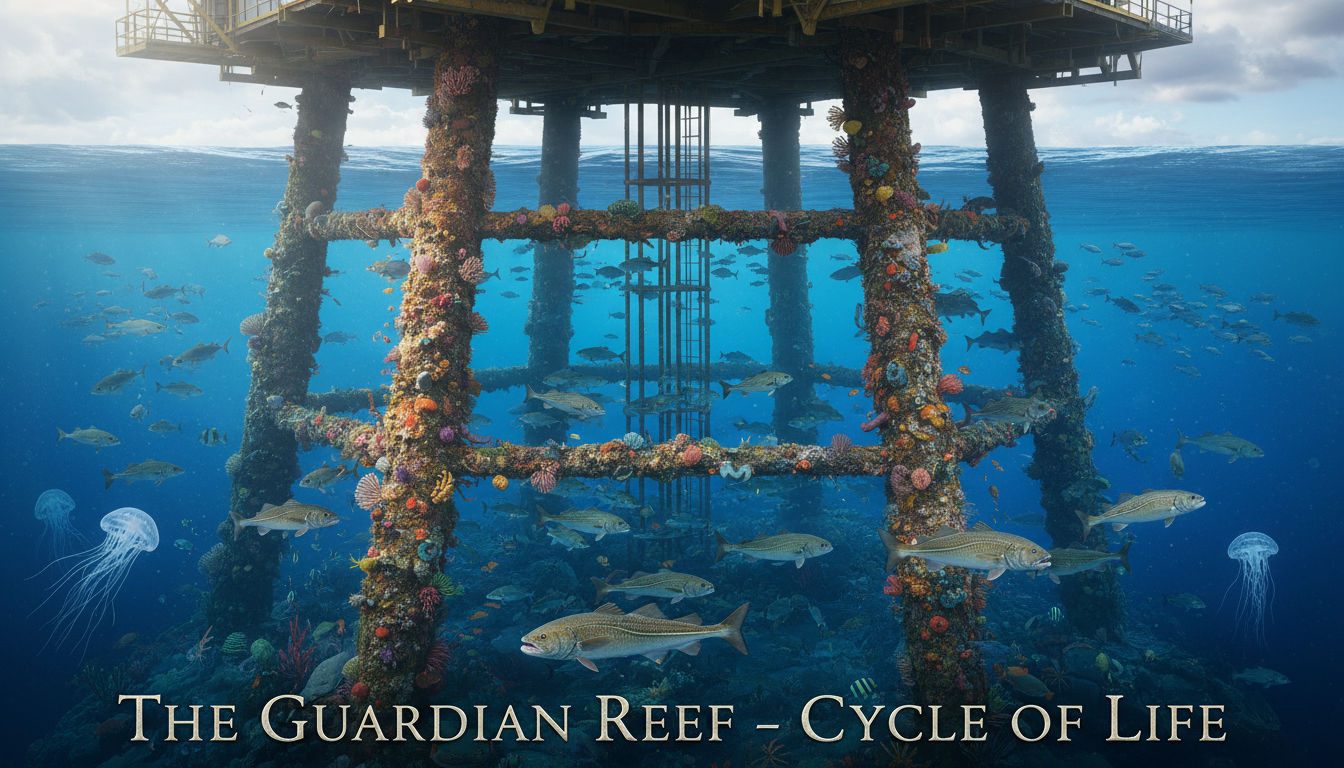
The Guardian Reef: An Ecological Imperative
Five decades of marine colonisation: offshore platforms have become critical biodiversity sanctuaries in the North Sea
The Paradox We Face: In the name of environmental protection, we are preparing to destroy one of the most biodiverse marine ecosystems we have accidentally created in the North Sea.
Half a Century of Marine Sanctuary
For over 50 years, offshore oil and gas platforms have stood as unintended guardians of North Sea marine life. What began as industrial infrastructure has evolved into something far more ecologically significant:
thriving artificial reef systems that now support complex, multi-trophic marine communities found nowhere else in these waters.
The steel jacket structures, subsea foundations, and exclusion zones around these platforms have created
de facto marine protected areas – sanctuaries where fish populations have flourished, invertebrate colonies have established themselves across every available surface, and apex predators have returned to hunt in waters that were once barren seabed.
The Marine Biodiversity We Stand to Lose
500+
Offshore platforms in UK North Sea waters
50+ years
Of continuous marine habitat development and species colonisation
500m radius
Exclusion zones protecting marine life from bottom trawling and vessel traffic
10-100x
Higher fish biomass around platforms compared to surrounding seabed (scientific studies)
What Lives on These Structures
Marine biologists studying North Sea platforms have documented extraordinary biodiversity:
Cold-water coral colonies and anemone gardens covering jacket legs and crossbeams
Dense mussel beds (blue mussels, horse mussels) providing habitat structure for hundreds of smaller species
Sponge communities filtering tonnes of seawater daily, improving local water quality
Kelp forests and algal growth in the photic zone, creating nursery habitat
Commercial fish species including cod, haddock, whiting, pollack, and saithe using platforms as feeding and spawning grounds
Seabirds (guillemots, kittiwakes, fulmars) nesting on topsides and feeding in enriched waters below
Marine mammals including grey seals and harbour seals observed hunting near platform structures
The Trawler Exclusion Effect: Accidental Marine Protection
Perhaps the most significant ecological benefit has been entirely unintentional:
the 500-metre safety exclusion zones around each platform have functioned as no-take marine reserves for half a century.
What this means in practice: For 50 years, bottom trawlers – which scrape and disturb the seabed, destroying benthic habitats and juvenile fish populations – have been legally prohibited from operating within 500 metres of platform structures.
This has created islands of refuge where the seabed remains undisturbed, where fish can grow to maturity without being caught as bycatch, and where slow-growing species like cold-water corals can establish themselves without being repeatedly destroyed by fishing gear.
Scientific Evidence of the "Reef Effect"
Multiple peer-reviewed studies have documented what marine scientists call the "artificial reef effect" around North Sea platforms:
Fish abundance around platforms can be 10 to 100 times higher than on adjacent open seabed
Species richness (number of different species) is significantly elevated within platform exclusion zones
Platforms act as "stepping stones" for species dispersal across the North Sea basin
Juvenile fish survival rates are higher in the structural complexity provided by jacket legs and crossmembers
Some species now depend on platform structures as critical habitat – removing them could cause localised population collapses
The Decommissioning Dilemma: Environmental Destruction in the Name of Environmentalism
The Irony: Current decommissioning policy requires the complete removal of offshore structures in the name of "returning the seabed to its natural state."
But after 50 years, this IS the natural state. Generations of marine organisms have been born, lived, and died on these structures. Entire food webs now depend on them. Removing them is not restoration – it is habitat destruction.
What Decommissioning Actually Means for Marine Life
When a platform is decommissioned and removed, the ecological consequences are severe and immediate:
Habitat loss: Decades of coral, mussel, and sponge growth are ripped away and destroyed
Population displacement: Fish and crustaceans lose shelter, feeding grounds, and spawning sites
Trawler access restored: The 500m exclusion zone is lifted, and bottom trawlers return to scrape the seabed
Sediment disturbance: Removal operations stir up decades of settled sediment, smothering nearby benthic communities
Noise and vibration: Cutting and lifting operations cause acoustic trauma to marine mammals and fish
Loss of connectivity: Removing "stepping stone" habitats fragments marine populations across the North Sea
"We are about to destroy thriving marine ecosystems – ecosystems that took 50 years to develop – because we are following a policy written before we understood what we had created."
The Guardian Reef Solution: Repurpose, Don't Destroy
Project Britannia offers an alternative that serves both climate and biodiversity goals:
Climate Benefit
Repurposed platforms produce clean hydrogen using offshore nuclear power
Displaces fossil fuel use in industry and heating
Avoids carbon emissions from decommissioning (cutting, transport, recycling/disposal)
Extends asset life by decades, avoiding new construction emissions
Biodiversity Benefit
Preserves 50 years of marine habitat development
Maintains exclusion zones, protecting seabed from trawling
Allows continued use by fish, invertebrates, seabirds, and marine mammals
Avoids habitat destruction and population displacement
Creates precedent for "conservation through adaptive reuse"
A New Paradigm: Industrial Ecology
The Guardian Reef concept represents a fundamental shift in how we think about offshore infrastructure:
Not "industrial" vs "natural" – but recognising that after 50 years, these structures ARE part of the marine ecosystem
Not "removal" vs "abandonment" – but adaptive reuse that serves new purposes while protecting what has grown
Not "environment" vs "economy" – but solutions that deliver both clean energy and biodiversity protection
Precedent from the Gulf of Mexico: The US "Rigs-to-Reefs" programme has successfully converted hundreds of decommissioned platforms into permanent artificial reefs, with documented benefits for fish populations, recreational fishing, and marine biodiversity.
Project Britannia goes further: rather than simply leaving structures in place, we give them a new clean-energy purpose while maintaining their ecological function.
Do We Really Want to Destroy This?
The question we must ask ourselves is simple but profound:
Do we really want to rip out thriving marine ecosystems – ecosystems that provide shelter, food, and breeding grounds for thousands of species – when there is a better way forward that protects both the climate and the ocean?
For 50 years, these platforms have stood as unintended guardians of North Sea biodiversity. With Project Britannia, we can make that guardianship intentional, permanent, and productive – producing clean energy while protecting the marine life that now calls these structures home.
The Guardian Reef is not a compromise. It is a better outcome: clean hydrogen for industry, protected habitat for marine life, and a demonstration that we can solve multiple crises at once if we are willing to think differently.
Workforce & Just Transition
Protecting offshore skills, careers, and coastal communities – not repeating the 1980s
Skills Passport Approach
Britannia is designed to retain and redeploy the UK's offshore workforce through a Skills Passport programme:
Accelerate training recognition and requalification across offshore operations
Electrical systems, process safety, and maintenance disciplines
Nuclear-specific training pathways (ONR requirements)
Hydrogen safety and operations certification
Retraining pathways for Gas Safe engineers to support regional hydrogen boiler conversion rollouts
Avoid abrupt industrial decline in coastal communities
Create credible long-duration career pathways
Regional Impact: Aberdeen, Teesside, Humber, and wider coastal communities benefit from sustained offshore employment and supply chain activity. Ports can pivot to support new energy infrastructure with clear policy signals and credible timelines.
From Pilot to Planet: A Blueprint for the Future
Phase 1: A North Sea Pilot
The first phase of Britannia is deliberately modest:
a single pilot cluster – one Power Hub and a small number of repurposed platforms – in the UK North Sea, serving Teesside and the Humber.
The goal is to prove the concept:
Show that repurposed rigs can safely host large‑scale electrolysis and associated systems.
Demonstrate reliable 24/7 hydrogen production using an SMR.
Prove hydrogen pipeline export or alternatives from offshore to industrial clusters.
Make the circular economy real: captured oxygen, brine as a resource, and zero‑to‑minimum waste by design.
Test workforce transition and the "Skills Passport" approach in real projects.
Rolling Out as Rigs Retire
As other platforms in the UK sector approach end of life, they can be screened:
some will be too old or too costly to make safe for another life – those will still be decommissioned. But the better candidates can be converted into hydrogen satellites instead of becoming scrap.
In this way, Britannia grows
step by step
as the old oil and gas era winds down – avoiding a cliff‑edge and turning a decommissioning problem into a transition programme.
UK as First Mover
If the UK is first to build and prove this kind of offshore nuclear‑powered hydrogen cluster, we don't just solve our own problem – we create a
blueprint
for others:
Technical design patterns and safety cases for 1+4 offshore clusters
Standards for hydrogen pipeline conversion and integrity management
Best practice for circular use of brine and oxygen
Workforce transition models for offshore regions
That blueprint – the intellectual property of how to do this safely and practically – can then be adapted and licensed to other countries facing the same offshore decommissioning and decarbonisation challenges.
Not Built in a Boardroom
It's important to say how this started.
Project Britannia did not begin in a glass‑walled boardroom, with a hundred consultants on £1,000 an hour Putting it on the back burner so they keep earning loads for doing nothing. It was created by
one retired engineer, Dave Waugh, sitting in his kitchen, trying to stop history repeating itself.
That doesn't replace the need for serious engineering, regulatory scrutiny or large‑scale investment – all of that will be required. But it shows that
good ideas can come from people who have actually done the work,
not just from those who write slide decks about it.
Delivery Roadmap (2026-2032+)
Phase 0: Screening & Scoping (2026)
Outputs: Asset screening; shortlist pilot cluster; regulator pathway scoping; offtake mapping for Teesside/Humber; Skills Passport design; independent cost bands.
Phase 4: Commissioning & First Hydrogen (2029-2032)
Outputs: SMR delivery and commissioning (as licensed by ONR); integrated system commissioning; first hydrogen to shore; operational handover.
Timeline Note: This is a conservative, first-of-a-kind schedule. Actual delivery depends on licensing outcomes, supply chain readiness, and regulatory approvals. Parallel pathways (e.g., SMR licensing, platform works) can reduce critical path where safe to do so.
Recommendations & Next Steps
Recommendation
What It Enables
Lead Stakeholder
R1: Commission independent Phase-0 screening study (6-9 months)
Identify viable assets and corridors; shortlist 1 pilot cluster; confirm offtake; cost bands
DESNZ / NSTA
R2: Establish cross-regulator scoping group
Define regulatory pathway for offshore nuclear-adjacent industrial facility
Listen to a discussion the vision, technical details, and human story behind Project Britannia.
Research Documents & Supporting Materials
Download the full technical documentation, white papers, and briefing materials that support Project Britannia's proposals and claims.
Note: These documents contain detailed technical analysis, cost estimates, regulatory considerations, and supporting evidence for the concepts presented on this website. They are intended for policymakers, engineers, and stakeholders conducting due diligence.
Complete Document Pack
Document
Description
Download
Britannia Full Pack (.zip)
Complete Project Britannia document set including all policy documents, technical studies, engagement materials, and supporting research in a single archive
Document Updates: These documents are periodically updated as new research is completed and regulatory guidance evolves. Check back regularly for the latest versions.
Author's Statement & Disclaimer
Author: Dave Waugh (Retired Engineer)
This website presents a concept-level proposal to support policy and engineering discussion. It is not a substitute for operator data rooms, regulatory safety cases, environmental impact assessment, or formal Front-End Engineering Design (FEED).
No financial stake: The author holds no financial stake in any companies, technologies, or projects referenced and expects no financial benefit.
No formal affiliations: The author has no formal links to OPRED, NSTA, ONR, HSE, the IAEA, or named operators.
Technology references are illustrative: Any mention of vendors (e.g., Rolls-Royce SMR) is illustrative and not an endorsement or procurement recommendation.
Document status: Concept-level proposal. Not a safety case, not a FEED deliverable, and not a procurement specification.